Can You Get a Mortgage with a 630 Credit Score in 2026?
A 630 credit score can still qualify you for a mortgage — with options like FHA loans, some conventional programs with compensating factors, and alternative or non-prime loans — but approval often depends on your down payment, debt-to-income ratio, and overall credit profile
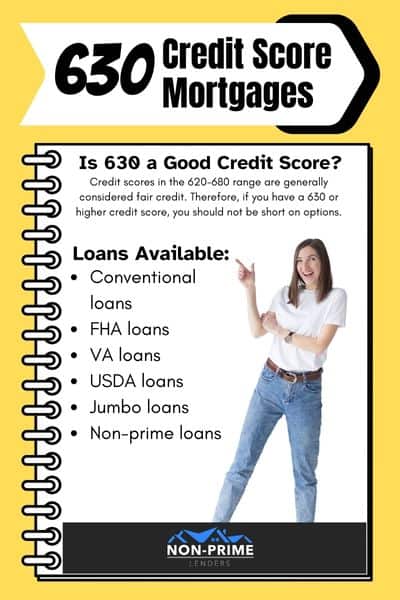
The types of programs that are available to borrowers with a 630 credit score are: conventional loans, FHA loans, VA loans, USDA loans, jumbo loans, and non-prime loans. With a 630 score, you may potentially be eligible for several different types of mortgage programs.
“Yes, it’s possible to secure a mortgage with a credit score of 630. To enhance your chances, you can consider options like FHA loans or USDA loans, which have more flexible credit score requirements. Additionally, working on improving your credit score through timely payments and reducing debt can further strengthen your mortgage eligibility.”
It’s important to remember that each lender has unique criteria for evaluating credit scores and approving mortgage applications. While one lender may reject an application, another might approve it. This emphasizes the significance of working with an experienced loan officer to increase the likelihood of approval.
The key is to find a loan officer who understands your unique financial situation and can offer the best terms based on your credit score.
For example, while one lender may heavily emphasize credit scores, another might consider factors such as stable employment history, income stability, and the applicant’s ability to make a down payment. This diversity in evaluation criteria opens up opportunities for applicants with slightly lower credit scores to be approved for a mortgage.
Contact us now to speak with a loan officer who can answer questions
For company and MLO licensing information go to: www.nmlsconsumeraccess.org (NMLS #1330)
Essential Requirements for Loan Approval
When it comes to securing a mortgage with a credit score of 630, several key factors come into play. Proof of stable income is crucial. Lenders want to ensure that you have a reliable source of income to support your mortgage payments. This can be demonstrated through pay stubs, tax returns, and employment verification.
In addition to income, having a sufficient down payment is important but not required. For example, FHA loans typically require a minimum down payment of 3.5%, while conventional loans require a down payment ranging from 3% to 5%. Saving up for a larger down payment can improve your chances of loan approval and result in lower monthly payments and reduced interest costs over the life of the loan.
Maintaining a low debt-to-income ratio is also paramount. Typically, conventional loans require a debt-to-income ratio of no more than 43%, while FHA loans allow for a slightly higher ratio of up to 56.9%.
Moreover, consistent employment in the same field for at least two years is often a requirement. A stable work history indicates financial stability and reassures lenders that you have the capacity to meet your mortgage obligations.
For borrowers considering USDA loans, it’s important to note that these loans are intended for properties in eligible rural areas and may have specific income limits.
Whether it’s demonstrating consistent income, securing an adequate down payment, managing debt responsibly, or meeting specific property location and income criteria, each requirement plays an integral role in shaping the approval process for obtaining a mortgage with a 630 credit score.
Mortgage Options With a 630 Credit Score
With a 630 credit score, you will have many mortgage options available to you. We will take you through the most common mortgage programs below. Then, reach out to us and we can discuss those options with you and provide a pre-approval.
Conventional Loan with 630 Credit Score
The minimum credit score requirement to get a conventional loan is 630. In order to qualify for a conventional loan, you will need to meet all other loan requirements. This includes having at least 2 years of steady employment, a down payment of at least 3-5%, and no recent major credit events (such as a bankruptcy or foreclosure).
Would you like to find out if you qualify for a conventional loan? We can help match you with a mortgage lender that offers conventional loans in your location.
Click here to get matched with a mortgage lender
FHA Loan with 630 Credit Score
FHA loans only require that you have a 580 credit score, so with a 630 FICO, you can definitely meet the credit score requirements. With a 630 credit score, you should also be offered a better interest rate than with a 580-619 FICO score.
Other FHA loan requirements are that you have at least 2 years of employment, which you will be required to provide 2 years of tax returns, and your 2 most recent pay stubs. The maximum debt-to-income ratio is 43% (unless you have satisfactory “compensating factors”, such as a higher down payment, or cash reserves).
Something that attracts many borrowers to FHA loans is that the down payment requirement is only 3.5%, and this money can be borrowed, gifted, or provided through a down payment assistance program.
Click here to find out if you qualify for an FHA loan.
USDA Loan with 630 Credit Score
The minimum credit score requirements for USDA loans is now a 640 for an automated approval. Fortunately, you can still get approved for a USDA loan with a 630 credit score, but it will require a manual approval by an underwriter. In order to get approved with a 630 credit score, expect to have strong “compensating factors”, such as conservative use of credit, 2 months mortgage payments in cash reserves (savings), a low debt-to-income ratio, and/or long job history.
Other requirements for USDA loans are that you purchase a property in an eligible area. USDA loans are only available in rural areas, as well as on the outer areas of major cities. You can not get a USDA loan in cities or larger towns.
You also will need to show 2 years of consistent employment, and provide the necessary income documentation (2 years tax returns, and 2 recent pay stubs).
Click here to find out if you qualify for a USDA loan
Steps to Improve Your Approval Chances
Securing a mortgage with a credit score of 630 may be challenging, but several actionable steps can increase your chances of approval.
Step I – Reduce Debt
One of the most important things you can do to improve your chances of getting approved for a mortgage is to pay down outstanding debts. Lenders closely scrutinize your debt-to-income ratio, which measures your monthly debt payments against your gross monthly income. Lowering this ratio by paying off debts signals to lenders that you are financially responsible and capable of managing additional debt. This reduces their risk and boosts your chances of approval.
Step II – Save for a Larger Down Payment
Another significant step you can take is saving for a larger down payment. A sizable down payment not only reduces the lender’s risk but also demonstrates your financial stability and ability to save. Additionally, a larger down payment can lower your mortgage insurance costs, making homeownership more affordable in the long run. By reducing the amount borrowed, a substantial down payment lessens the financial burden on both you and the lender.
Step III – Check Credit Reports
Obtaining your credit reports from all three major credit bureaus—Equifax, Experian, and TransUnion will help to identify any inaccuracies. Regularly reviewing your credit reports ensures that the information used to calculate your credit score is accurate. Even a small error correction can potentially boost your credit score, improving your overall creditworthiness in the eyes of lenders.
Step IV – Avoid New Credit Applications
Avoiding new credit applications in the months leading up to your mortgage application is essential. New credit inquiries can temporarily lower your credit score, potentially impacting your loan eligibility and the interest rates offered by lenders. It’s advisable to refrain from applying for new credit cards or loans before your mortgage application to maintain your current credit standing.
Another important thing is do not buy a new car until you close on the mortgage. You will significantly hurt your chances for an approval or at minimum obtaining a mortgage for the amount you are looking for.
By following these strategic steps, you can positively impact your creditworthiness and increase your chances of securing a mortgage with a 630 credit score. Each action demonstrates financial responsibility and stability, signaling to potential lenders that you are a reliable candidate for a home loan.
How Your Credit Score Affects Interest Rates
Interest rates are pimarily impacted by your credit scores. The higher the credit scores, the lower your interest rate will be. To a lesser degree, a larger down payment will also result in a lower rate.
We explain to our clients that managing credit is needs to become a way of life and not something you attempt to do while applying for a mortgage. Although we can help to some degree with improving credit scores, there are often credit problems that cannot be fixed overnight.
630 Credit Score Mortgage Lenders in 2026 – What to Look For
When searching for a lender who can help with a 630 credit score, you really should work with a broker like us. It is because some brokers have a whole network of wholesale lenders that offer programs which make it easier to qualify with lower credit.
Another key is to work with a loan officer who specializes in lower credit. They will be familiar with how to prepare your application to have the highest chance of approval before sending it to the underwriter.
You will also have a variety of options when it comes to interest rates. Your loan officer can shop your deal to find the best offer possible given your loan scenario, credit, and more.
Click here to speak with one of our loan officers who can help
Is 630 a Good Credit Score?
From a lending perspective 630 is considered to be a “fair” credit score. You can still get approved for virtually any type of mortgage if you are working with the right lender. However, the rate you are offered may not be as low versus what you may get with a much higher credit score.
If your credit score is 630 we suggest you allow us to help with your mortgage while you simultaneously work on improving your scores so you can get the best rate possible.
Can I Buy a House with a 630 Credit Score?
You can absolutely buy a house with a 630 credit score if you are speaking with a lender who is willing to accept 630. With a 630 score, you can potentially qualify for a conventional, FHA, VA, USDA and even a subprime loan.
How Much Can I Borrow with a 630 Credit Score?
The mount you are able to borrow is not tied to your credit score. With a 630 credit score, you should have the ability to borrow virtually any amount that you need. You will be limited based upon your income, debt to income ratio, down payment, and lender loan limits.
Frequently Asked Questions
Can you get a mortgage with a 630 credit score?
Yes — many borrowers with a 630 credit score can qualify for a mortgage, especially through FHA loans, some conventional lenders with compensating factors, or alternative lending programs. Approval depends not only on credit but also on your down payment, DTI (debt-to-income ratio), and employment history.
What types of loans can someone with a 630 score get?
Borrowers with a 630 credit score may qualify for:
-
FHA loans — popular option with flexible credit guidelines
-
Conventional loans — possible with stronger financial profile
-
Non-prime or alternative mortgage programs — flexible documentation
Each has different requirements for down payment, rates, and documentation.
How much down payment is typically required with a 630 credit score?
With an FHA loan, you may qualify with as little as 3.5% down if other criteria are strong. Conventional loans at 630 often require 5%–10% down, and non-prime lenders may request larger down payments.
Will having a 630 credit score affect my interest rate?
Yes — credit scores strongly influence interest rates. A 630 score typically faces higher interest than scores above 700, but FHA and non-prime programs help lower the barrier to entry at the cost of slightly higher rates.
What compensating factors help if my score is 630?
Compensating factors can boost approval odds and include:
-
Low DTI ratio
-
Stable employment history
-
Larger down payment or cash reserves
-
Strong rent or payment history
Do FHA lenders always accept a 630 score?
FHA guidelines allow scores as low as 500, but many lenders apply overlays and prefer a score of 580 or higher. You may need to shop for lenders willing to manually underwrite or accept compensating factors.
How does a 630 credit score affect monthly mortgage insurance?
On FHA loans, mortgage insurance costs are standard regardless of credit score, but conventional loans at 630 may require PMI (private mortgage insurance) until you reach sufficient equity.
Can I qualify for conventional financing with a 630 score?
Yes, but conventional lenders often require other strengths in your profile (low DTI, solid reserves, larger down payment). A 680+ score typically gets better conventional rates and terms.
Can I refinance later if I buy with a 630 score?
Absolutely. Many borrowers purchase with an FHA or non-prime loan and then refinance into a conventional loan once their credit improves.
How can I quickly improve my 630 credit score?
To improve your score:
-
Pay down credit cards (keep utilization below 30%)
-
Avoid new credit inquiries before applying
-
Correct errors on your credit report
-
Consistently make on-time payments
Small improvements can significantly impact mortgage approval and rate.
Does debt like student loans impact my ability to qualify at 630?
Yes, debt affects your DTI ratio more than your score alone. Even with a 630 score, low monthly obligations and strong income can improve your approval chances.
Are there lenders that specialize in lower credit scores like 630?
Yes — some lenders specialize in non-prime or manual underwriting mortgages that accept borrowers with scores in the low 600s. These lenders consider alternative documentation and compensating factors more heavily.
Are there government programs available that can help me get a mortgage with a 630 credit score?
You can apply for government backed mortgages such as FHA, VA, and USDA.
What documentation will I need to provide to get a mortgage with a 630 credit score?
You will need to provide your latest pay stubs and bank statements, plus your last two years of W2s and tax returns.
Can I get a jumbo loan with a 630 credit score?
The minimum credit score required to get a jumbo loan depends on the lender. Most jumbo lenders require a borrower to have a credit score of at least 720. However, there are several non-prime lenders that offers jumbo loans to borrowers with credit scores as low as 600.
Can I get a VA loan with a 630 credit score?
If you are eligible for a VA loan (which are exclusively for veterans), you may be able to qualify with a 630 credit score.
What if I have had a major credit issue in recent years?
If you have had a bankruptcy, foreclosure, or short sale, there are several non-prime lenders that offer home loans to borrowers even just 1 day after such events.
Are there other credit requirements that I should know about?
Most mortgage lenders require that you have 3 trade-lines on your credit report. This can be auto loans, credit cards, personal loans, or other qualifying lines of credit. There can be exceptions to this rule, including alternative bills that are often allowed (phone bills, utilities, etc.).
What are the interest rates for a borrower with a 630 credit score?
The interest rate will depend on your individual qualifications, the mortgage lender, and the date you lock your interest rate. We can help connect you with a mortgage lender that offers free rate quotes. To have a mortgage lender contact you, please fill out this form.
Is down payment assistance available to someone with a 630 credit score?
Yes, in fact many down payment assistance programs are available to borrowers with a 630 credit score. The types of programs that exist include both local (city, county, or state level), and nationwide programs. A mortgage lender can help you see if you qualify for down payment assistance. If you have lower income, you are even more likely to qualify, as these programs are often intended for lower income households.